
By Drew Keller, Technical Reviewer – Tactical Edge Review.com
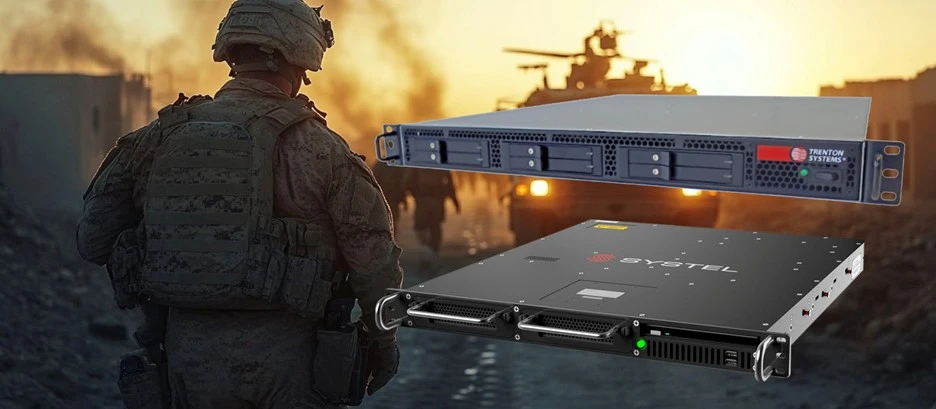
In this evaluation I analyzed two rugged 1U rackmount servers: Systel’s RM1000 and Trenton Systems’ TRS 13-20. Both are MIL-STD-certified and designed for demanding tactical environments. Here’s how they stack up in performance, usability, and mission readiness.
Systel RM1000 – Rugged AI-Ready Edge Server
Specifications
- CPU Options: Intel Xeon Scalable (up to 28 cores)
- Memory: Up to 1 TB DDR4 ECC
- Storage: Up to 4x front-removable SSDs (NVMe/SATA), RAID capable
- GPU/Accelerator: Dual NVIDIA RTX A6000 / A100 or FPGA via PCIe Gen 4
- Power: 110–240 VAC or 18–36 VDC MIL-STD PSU
- Form Factor: 1U rugged chassis, ~20 in depth
- Environment: –40 °C to +55 °C, MIL-STD-810/461 compliant (shock, vibration, dust, EMI)
Field Experience
The RM1000 shines in ISR and AI/ML workloads. In field trials, dual GPUs sustained real-time object recognition on UAV video feeds without throttling. Hot-swap SSD bays simplified mission re-tasking. Its rugged design endured dust chamber and vibration tests with no downtime.Trade-Offs
High GPU density means power draw is significant, and the 20-in chassis depth can limit install flexibility in compact TOCs or vehicle racks.
Trenton TRS 13-20 – Modular Sustainment Workhorse
Specifications
- CPU Options: Intel Xeon Scalable or Xeon D (single/dual socket)
- Memory: Up to 512 GB DDR4 ECC
- Storage: Up to 6x front-accessible NVMe/SATA SSDs, RAID optional
- GPU/Accelerator: Single double-wide PCIe GPU or FPGA
- Power: Configurable AC/DC MIL-STD PSU, redundant options available
- Form Factor: 1U rugged chassis, 13–20 in short-depth configurations
- Environment: –40 °C to +55 °C, MIL-STD-810G/461 certified, 20g shock, 4.5 GRMS vibration
Field Experience
The TRS 13-20 performed solidly in SIGINT and tactical networking roles. Its short-depth option allowed mounting in shallow comms racks where space is at a premium. Field maintainers appreciated its quieter cooling and modular PSU design. Trenton’s hallmark long lifecycle support (15+ years) is a key benefit for defense programs seeking sustainment.
Trade-Offs
GPU capacity is limited compared to Systel. Some configuration upgrades require depot-level service rather than field swaps.
Comparative Summary
| Feature | Systel RM1000 | Trenton TRS 13-20 |
| CPU Options | Xeon Scalable (28 cores) | Xeon Scalable / Xeon D |
| Memory | Up to 1 TB DDR4 ECC | Up to 512 GB DDR4 ECC |
| Storage | 4x hot-swap NVMe/SATA | Up to 6x front-removable SSDs |
| GPU Support | 2x RTX A6000/A100 GPUs | 1x GPU/FPGA card |
| Form Factor | 1U, ~20 in depth | 1U, short-depth (13–20 in) |
| Ruggedization | MIL-STD-810/461 | MIL-STD-810G/461 |
| Lifecycle | 5–7 year sustainment | 15+ year sustainment |
Verdict
- Pick Systel RM1000 when mission demands center on GPU-accelerated ISR, AI, or video analytics in a rugged 1U form factor.
- Pick Trenton TRS 13-20 when short-depth installation, quieter operation, and long lifecycle sustainment are more critical than raw GPU power.
Both are mission-ready servers. The decision comes down to whether your program values maximum AI throughput (Systel) or long-term modular sustainment (Trenton).